
Walls or the Kitchen? Choosing the Right Racket Sport
Wall rebounds define padel; pickleball hinges on the kitchen and two-bounce rule. Compare equipment, scoring, formats and practical fit.
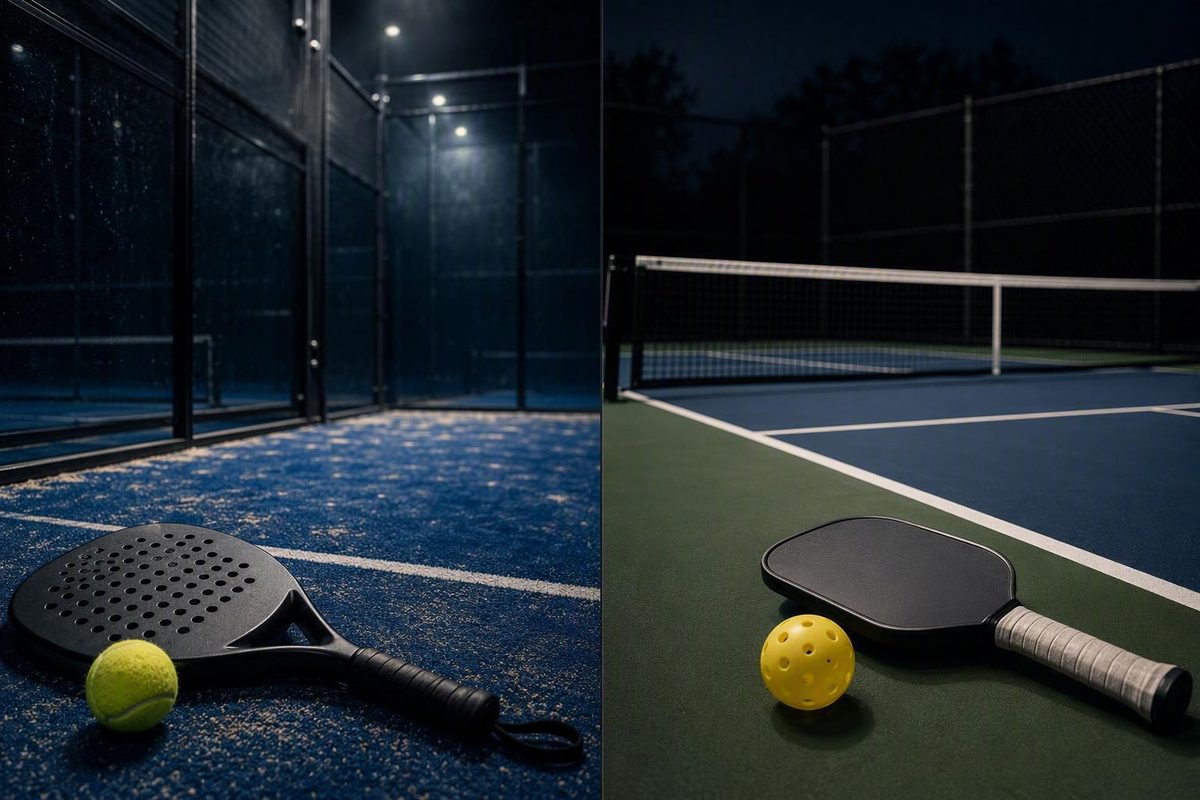
Padel and pickleball are distinct sports, not variations of the same game. Padel is centred on doubles and played on a 20 m × 10 m enclosed court, where permitted wall rebounds can keep the ball alive. Pickleball routinely supports singles and doubles on a 20 ft × 44 ft open court shaped by a seven-foot non-volley zone—the kitchen—and a two-bounce rule. They also use different equipment and common scoring systems. Choose according to local court access, partner availability, and whether wall play or kitchen-based placement appeals more.
The short answer: padel and pickleball are not the same sport
The quickest way to distinguish padel from pickleball is to look at the court. A regulation padel court measures 20 m by 10 m and is enclosed. A pickleball court measures 20 ft by 44 ft and normally has no playable walls; instead, it has a seven-foot non-volley zone on each side of the net. The LTA’s padel and pickleball comparison also distinguishes the sports by equipment, scoring, wall use, and typical player format.
| Feature | Padel | Pickleball |
|---|---|---|
| Court | 20 m × 10 m | 20 ft × 44 ft |
| Defining court feature | Enclosure with permitted wall play | Seven-foot kitchen on each side |
| Racket or paddle | Solid, stringless, perforated racket | Rigid, flat-faced paddle |
| Ball | Lower-pressure tennis-style ball | Hollow, perforated plastic ball |
| Serve | Underhand, diagonal, after a bounce | Underhand and diagonal |
| Common scoring | Tennis-style points, games, and sets | Often to 11, win by two |
| Standard format | Doubles; singles variants exist | Singles or doubles |
| Signature tactic | Reading rebounds and covering space as a pair | Managing the kitchen line and controlled short shots |
These are standard or common formats, not promises about every club night or competition. Padel is centred on doubles, but singles variants and dedicated singles courts exist. Pickleball routinely supports singles and doubles, while its scoring format can vary. Confirm the format before play.
The defining contrast is walls versus the kitchen. In padel, a ball that bounces legally on the receiving side may remain live after rebounding from a permitted wall. In pickleball, there is no wall play; its defining court restriction governs where players may volley.
How a rally works in each sport
A worked point makes the rules easier to understand than a list of definitions.
A basic padel rally might begin like this:
- The server stands behind the service line and bounces the ball.
- The server strikes it underhand into the diagonal service box.
- If the first attempt is a fault, the server normally has a second attempt.
- The receiver lets the serve bounce, then returns it.
- Later in the rally, a shot lands legally in the opponents’ court and rebounds from a permitted wall.
- The opponents may play it before its second bounce.
That is an introductory sequence, not a complete wall-and-fence rulebook. The order of the bounce and enclosure contact matters, and not every wall or fence sequence is legal. For a first session, remember that a ball can remain live after passing you and reaching the back glass—but first establish that it bounced legally. The LTA comparison outlines the bounced underhand serve and the requirement for a shot to bounce on the opponents’ side before reaching a playable wall.
A basic pickleball rally works differently:
- The server sends an underhand serve diagonally into the opposite service court.
- The receiving side lets the serve bounce.
- The receiver returns it, and the serving side lets that return bounce.
- Only after those two required bounces may either side volley.
This is pickleball’s named two-bounce rule. It should not be copied wholesale into padel. USA Pickleball’s gameplay overview confirms that the serve must bounce on the receiving side and the return must bounce on the serving side before volleys begin.
The kitchen rule is narrower than its nickname suggests. A player may enter the kitchen to play a ball that has bounced. The kitchen is therefore not forbidden ground—it is a non-volley zone.
Why walls and the kitchen produce different tactics
Padel’s enclosure changes what counts as a recoverable ball. Rather than treating every shot that passes the body as lost, a defender can track its legal bounce, read the rebound from the back or side wall, and choose a return. That creates decisions about when to move forward, when to retreat, who covers the middle, and whether a rebound offers time to reset the point.
Because standard padel is played as doubles, those decisions are shared. One player’s movement affects the space available to the other. Partners need to cover the court together rather than chase independently, particularly when a lob or angled rebound moves the pair away from the net.
Pickleball removes the rebound calculation but adds a different positional problem. Players cannot simply crowd the net and volley from anywhere: the kitchen line establishes the nearest legal position for a volley. This encourages controlled drops and dinks, patient placement, and quick exchanges near the non-volley line.
Neither pattern is inherently more strategic. Padel asks players to judge rebounds, angles, and shared coverage inside an enclosure. Pickleball asks them to control short balls, manage the non-volley line, and decide whether to take a ball after a bounce or as a legal volley.
A useful court comparison would show the 20 m × 10 m padel enclosure beside a 20 ft × 44 ft pickleball court, with the padel back and side walls labelled and both seven-foot kitchen zones marked.
Rackets, paddles, and balls are not interchangeable
A padel racket is solid, stringless, and perforated. Carbon-fibre and fibreglass constructions are common, and the racket has a wrist strap. Its fuzzy rubber ball resembles a tennis ball but uses lower pressure.
A pickleball paddle is rigid and flat-faced rather than perforated like a padel racket. Its ball is hollow plastic with holes, and indoor and outdoor pickleballs can use somewhat different designs. These equipment distinctions between padel and pickleball affect how the balls travel and rebound.
Use equipment made for the sport you are playing. A pickleball paddle is not a substitute for a padel racket, and a plastic pickleball cannot reproduce the response of a padel ball. Although both sports use solid striking surfaces, the rackets or paddles, balls, and resulting rebounds differ.
For a first session, bring or arrange:
- The correct padel racket or pickleball paddle
- The correct ball for the sport and setting
- Court-appropriate shoes
- Access to the proper court
Ask your chosen venue whether rental equipment and balls are available before arriving.
Scoring, serving, and player formats compared
Padel commonly uses the tennis progression of 15, 30, 40, and game. Games form sets, and matches are commonly organised as best of three sets. Some formats use a golden point to decide a game at deuce rather than continuing through advantage, so confirm the format with the venue. The LTA comparison supports the standard tennis-style structure, while comparison material from the PPA Tour documents best-of-three-set matches and two serve attempts.
Traditional pickleball side-out scoring works differently. Games are commonly played to 11 and must be won by two points, with only the serving side scoring. Games to 15 or 21 also exist, and some competitions or recreational groups use rally scoring, so local or competition rules control both the target and who may score. USA Pickleball’s overview describes the common side-out format of games to 11, win by two.
The serves share a broad concept but not an identical procedure:
| Detail | Padel | Pickleball |
|---|---|---|
| Direction | Diagonal | Diagonal |
| General action | Underhand after bouncing the ball | Underhand |
| Common attempts | Two | One |
| Serve return | Receiver lets the serve bounce | Receiver lets the serve bounce |
| Following shot | Normal padel rally rules apply | Serving side must let the return bounce |
Both serves are generally underhand and diagonal. The padel serve is struck after a bounce and commonly allows two attempts, while the standard pickleball serve generally allows one. Pickleball then requires the serving side to let the return bounce; that extra required bounce is not a rule to import into padel.
Player formats also differ. Pickleball uses the same 20-by-44-foot court for singles and doubles and routinely supports both formats. Padel is centred on doubles, with its regulation doubles court, partner movement, and shared coverage defining the standard game.
For either sport, check three details before a match begins: the scoring method, the number of games or sets, and any venue-specific competition format.
Which should you try? Use access and playing style to decide
Start with access, not abstract arguments about which sport is better. Regulation padel requires a dedicated enclosure with suitable walls and fencing. Pickleball can often be marked on a suitable existing surface, although temporary lines and a portable net do not turn every improvised setup into a dedicated court.
Search locally before buying equipment. A sport may suit your preferences but still be impractical if it requires a long journey, a membership, or partners who are difficult to organise.
| Priority | Likely fit | Reason |
|---|---|---|
| Routine singles play | Pickleball | Singles is a regular format |
| Open-court play | Pickleball | There are no wall rebounds to read |
| Dinks and kitchen exchanges | Pickleball | The non-volley zone shapes positioning |
| A regular group of four | Padel | Doubles is the standard format |
| Learning wall rebounds | Padel | The enclosure is an active tactical feature |
| Coordinated partner coverage | Padel | Pair movement is central to standard play |
| Easiest local routine | Whichever is nearby | Travel, booking, and partner access matter |
Do not assume pickleball will always be cheaper or padel will always be more expensive in practice. Compare the local total:
- Court hire or drop-in fee
- Membership requirements
- Racket or paddle rental
- Ball provision
- Introductory coaching
- Travel time and cost
- Open-play availability
- Need to organise partners
Difficulty and physical demand are personal and context-dependent. Prior racket experience, mobility, instruction, partners, match level, and court conditions can all alter a first impression. The cleanest comparison is an introductory session in each sport, ideally with borrowed or rented equipment and a short rules explanation.
What transfers—and what must be unlearned
Players arriving from pickleball will recognise the broad concept of an underhand diagonal serve. Almost everything around that starting point changes, however. Padel has no kitchen, generally uses tennis-style scoring, requires a different racket and ball, and permits certain post-bounce wall rebounds.
A pickleball player’s kitchen awareness can become an unnecessary boundary in padel because there is no equivalent non-volley zone. Conversely, pickleball’s named two-bounce rule does not transfer: learn padel’s serve-return and wall rules on their own terms.
Tennis players will find padel’s scoring and tennis-style ball more familiar. A legal rebound may return it to a playable position, so turning away too soon can concede a point that is still alive. Players making that transition can use Padel Primer’s tennis-oriented padel rules guide for additional context.
Common first-session mistakes include:
- Bringing a pickleball paddle or tennis racket to padel
- Using a padel ball for pickleball, or vice versa
- Volleying before pickleball’s serve and return have each bounced
- Volleying while in contact with the pickleball kitchen
- Treating every padel wall or fence contact as legal
- Giving up on a padel ball before judging its rebound
Before starting, ask which scoring format the venue uses. Then get a brief explanation of the rule that organises the court: legal wall sequences in padel, or the kitchen and two-bounce restrictions in pickleball.
Try pickleball if singles flexibility, an open court, and kitchen-based placement suit you—and local courts make it easy to join. Try padel if wall rebounds, coordinated doubles, and enclosed-court positioning sound more appealing. Compare nearby venues and take an introductory session in each before deciding which is easier, less expensive, or more physically demanding for you.