
How to Read and Return an Open Double-Glass Rebound
Prepare early, use small adjustment steps to create space toward the middle, read the second rebound, then contact in front before bounce two.
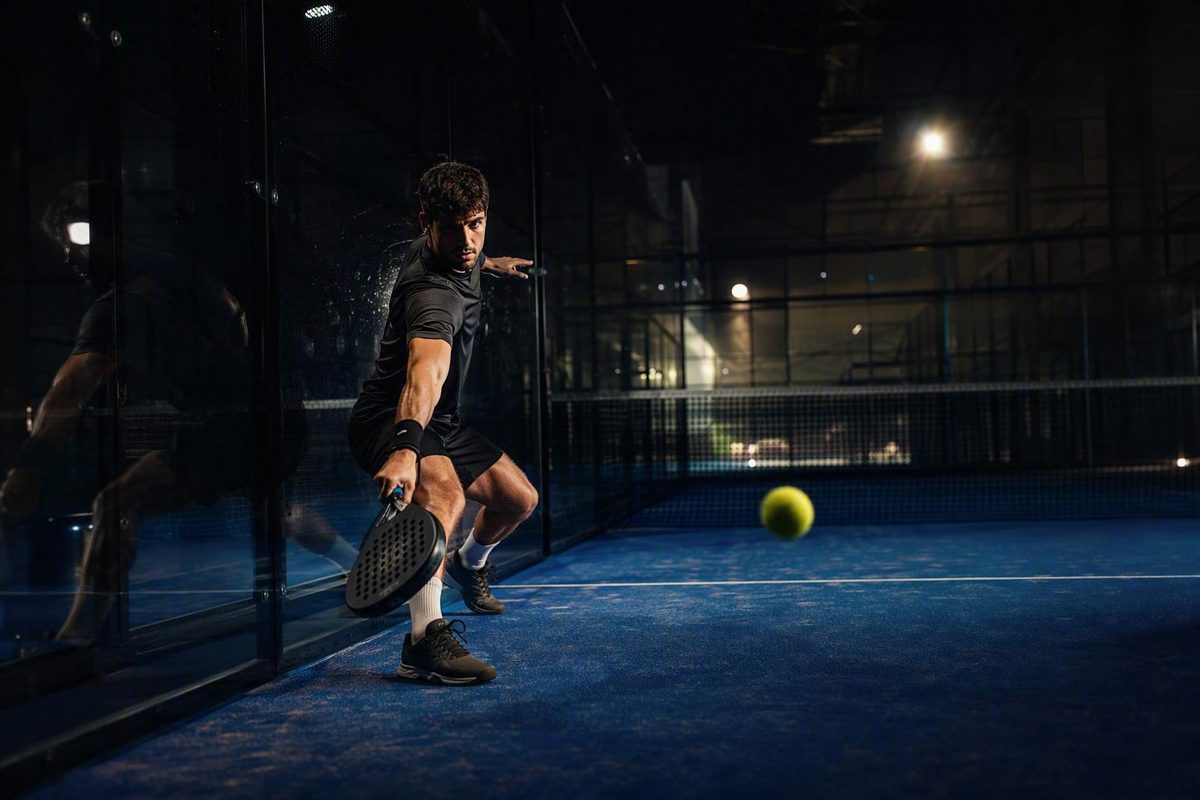
When a cross-court ball bounces on your side, hits the side glass and then the back glass, resist the urge to chase it into the corner. Prepare early, use small adjustment steps to create space toward the middle, let the second rebound reveal the exit, and contact the ball in front before its second floor bounce.
The quick answer: make space toward the middle
Use this sequence:
- Recognize the incoming cross-court path.
- Prepare your racket before the ball reaches the glass.
- Move away from the corner, generally toward the middle.
- Let the side-glass-then-back-glass rebound develop.
- Meet the ball in front with a controlled return.
The key is space. If you crowd the corner, the ball can leave the back glass behind your body. Moving toward the middle opens a channel for the rebound to emerge and gives you room for final adjustments.
The reverse order—back glass followed by side glass—is called a closed double glass in the same material. The Active Away coaching notes teach the open pattern by creating space toward the middle and allowing the ball to come in front.
This exact movement problem also appears in a recreational player’s question about defending a cross-court double-glass rebound. One discussion cannot show how widespread the problem is, but it captures the practical dilemma: when two walls redirect the ball, which way should you move?
“Toward the middle” is a starting model, not a fixed route or destination. Pace, spin, height, angle and your starting position determine how much space you need and where the eventual contact will be.
Is side glass then back glass legal?
Yes. During a rally, the ball remains playable when your opponent’s shot bounces on your court first and then touches the side glass and back glass. You must return it before its second floor bounce. Redline Sports Club’s third-party rules guide explicitly lists both side-wall-to-back-wall and back-wall-to-side-wall sequences as legal after the first court bounce.
Floor bounce → side glass → back glass → return before the second floor bounce
The broader wall-play rule is straightforward: the incoming shot must land in the receiving court before touching its wall or cage, and the receiving team must return it before bounce two. If the shot reaches the opponents’ wall or cage before landing in their court, it is out under the LTA wall rules.
Wall or cage first → floor = out
In other words, an opponent cannot hit directly into the glass or cage on your side and rely on a later floor bounce to keep the shot in play. The floor contact has to come first.
Serve rules are narrower, particularly where the cage is involved. Do not assume that every wall or cage interaction allowed during a rally is also allowed after a serve.
A five-step movement pattern for the open double glass
1. Read the cross-court angle
Identify whether the incoming ball is deep and angled enough to reach both glass panels. Do not automatically attack it immediately after the floor bounce or commit to a contact point as soon as it reaches the side glass.
Watch its speed, height and direction into the corner. Your first task is to recognize the likely path. You can decide where to strike only after you have enough information about the rebound.
2. Prepare early and adjust in small steps
Set the racket early, then use short adjustment steps to manage the changing distance between your body and the ball. One large move may take you into the right general area but leave you unable to respond when the rebound exits differently than expected.
Early preparation does not mean beginning the swing early. Keep the racket ready while your feet continue to solve the spacing. The stroke should remain compact until the ball’s exit is clear.
3. Create space away from the corner
Move generally toward the middle so the ball can leave the glass without becoming trapped behind you. You are not abandoning the shot or simply running sideways; you are opening a playable channel between your body and the corner.
Avoid memorizing a fixed distance from the glass. A fast, deep ball may require more room. A softer rebound may lose pace and require you to move forward again. Your initial movement creates space, while your adjustment steps refine it.
4. Let the two-wall sequence develop
Track the ball through both wall contacts:
Side glass → back glass → exit into the court
Make your final adjustment to the exit you actually see. Pace, spin, height, angle and your original court position can all change the required spacing. Preserving balance and room to move is more reliable than trying to stand on one predetermined contact spot.
Letting the sequence develop does not mean becoming passive. Your racket should already be prepared, your feet should remain active and your body should be positioned to move forward if the rebound finishes shorter than expected.
5. Contact in front and recover
Play the ball in front of your body with a compact, controlled stroke. Prioritize direction, height over the net and recovery with your partner rather than trying to manufacture power from a defensive corner.
In padel, allowing the glass to redirect the shot can turn a cramped half-volley into a more balanced contact. The objective is not to wait automatically; it is to recognize when the rebound gives you a better option.
Wait for both walls or take the ball earlier?
You do not have to let the ball hit both walls. Waiting for the complete rebound is simply a useful beginner-friendly default when the incoming shot is deep, fast or difficult to read.
| Option | When it fits | Main cue |
|---|---|---|
| Wait for both walls | The ball is deep, fast or difficult to read | Preserve space and track the full exit |
| Intercept earlier | You have time for balanced, controlled contact | Do not reach or swing from a cramped position |
| Step forward after wall two | The rebound loses pace or floats short | Move up and meet it in front |
An early interception can be effective when you are already balanced and can control the return. It is a poor choice when “early” means lunging because you remained too close to the corner.
Two wall contacts reduce the ball’s energy, but that does not make every second rebound slow, easy or predictable. Respond to the observed rebound rather than memorizing one contact point or assuming the ball will always reach you at the same speed.
A useful decision rule is: wait unless taking it earlier gives you a clearly balanced contact. If you wait and the full rebound then dies short, step forward to meet it rather than remaining behind the ball.
Open versus closed double glass
The labels describe the order in which the ball meets the two glass panels after bouncing.
| Contact order | Common coaching term | General reading cue |
|---|---|---|
| Side glass → back glass | Open double glass | Create space toward the middle and let the ball emerge in front |
| Back glass → side glass | Closed double glass | Recognize the reversed path and read its actual exit |
Reversing the wall order changes the ball’s path. Do not see “two walls” and automatically use the open-pattern movement. On a closed double glass, the back glass comes first, so you must track the resulting path rather than force the same movement sequence.
The distinction is useful because it prompts earlier recognition. It is not a substitute for watching the ball. Even within the same named pattern, different speed, spin and angle can produce a different exit.
Common mistakes and a progressive practice drill
Common mistakes to watch for include:
- Crowding the corner: The rebound exits behind the body.
- Preparing late: The player waits for both wall contacts before setting the racket.
- Committing after the first wall: The player guesses instead of reading the second rebound.
- Letting the ball pass behind the body: The eventual contact becomes rushed or impossible.
- Using one large step: The player reaches the general area but cannot make fine adjustments.
- Adding power too soon: Balance and direction are sacrificed before the rebound is under control.
Learn the movement below match speed before trying to reproduce it during competitive points:
- Observe the path. Ask a partner or coach to send slow, deep cross-court feeds into one corner. On the first few feeds, simply track the floor, side-glass and back-glass contacts.
- Rehearse the spacing. Move toward the middle, preserve room for the exit and catch the ball—or return it very gently—in front of your body.
- Add controlled strokes. Play compact forehand and backhand returns toward a large, safe target.
- Vary the feed. Gradually change the direction, height and pace so you must adjust rather than repeat one memorized position.
- Use conditioned points. Let the feeder try to create the corner rebound during a cooperative rally, then progress toward normal point play.
Do not judge the drill by whether you hit a winner. A successful repetition means you stayed balanced, maintained space, kept the rebound in front and returned it with control.
Finish by repeating one cue on every feed:
Floor, side, back—make room, let it emerge, play it in front.
Learn that path with slow feeds first. In live play, you can then decide whether to wait for both walls or intercept earlier without rushing the decision.
Do the same wall rules apply when returning a serve?
Not completely. The serve must first land in the correct diagonal service box. After that bounce, contact with the glass can remain playable, but a serve that then contacts the cage is out under the LTA’s serve and wall rules. Rally rules allow broader post-bounce use of the walls and cage, so do not transfer every rally sequence directly to the return of serve.