
How to Recover After Every Shot Instead of Freezing
Use the “hit, recover, prepare, read, move” cue to regain balance, prepare early and reposition with your partner after every shot.
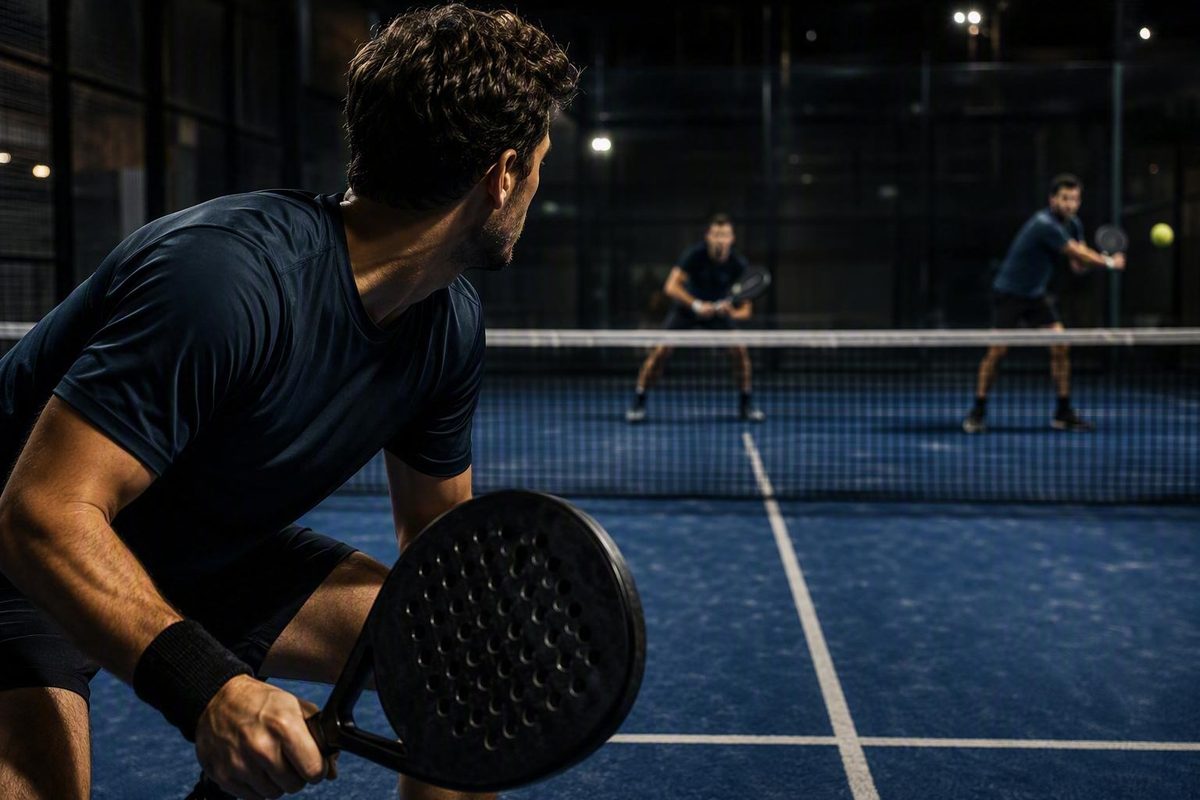
To stop ball watching in padel, do not look away from the ball. Stop treating your shot as the end of the rally. After every contact, use one repeatable cue: hit, recover, prepare, read, move. Regain your balance, take purposeful adjustment steps, prepare the racket early, read the developing play and reposition with your partner before your opponents play their next shot.
Ball watching is a recovery problem, not a reason to look away
In this context, “ball watching” means passively observing the result of your shot while remaining planted or failing to prepare. Useful ball tracking is different: you still need to follow the ball’s speed and direction, judge what your opponents can do and anticipate a possible rebound from the glass.
One player described the problem as standing still to assess the previous shot rather than preparing for the next one. That self-reported ball-watching example illustrates what the pause can feel like, but it does not show how common the habit is or what causes it.
The habit becomes visible through actions such as:
- Admiring a strong shot or waiting to see whether it succeeds.
- Staying in the position where contact occurred.
- Dropping the racket and preparing it only when the next ball is already coming.
- Losing useful alignment with a partner who has moved.
- Reacting only after an opponent begins—or even completes—the next stroke.
The important distinction is between watching for information and watching for an outcome. Information helps you prepare.
This distinction is especially relevant around the glass. You may need to judge the incoming ball’s speed, direction and likely rebound while moving into a suitable position. Your eyes continue tracking the rally, but your feet and racket begin preparing for what comes next.
A visible pause can be identified without diagnosing its cause. One player might be off balance after contact; another may be uncertain about positioning, prepare the racket late or simply be tired. The pause tells you what happened, not why it happened.
Use one cue after every contact: hit, recover, prepare, read, move
Use this five-part sequence as a memorable coaching cue rather than a rigid or scientifically validated protocol:
- Hit
- Recover
- Prepare
- Read
- Move
Hit
Complete the stroke without immediately judging it as good or bad. Once the ball has left your racket, the useful question is no longer, “Was that a good shot?” It is, “What does that shot allow us to do next?”
This does not mean cutting the stroke short. Finish it with control, then direct your attention towards the next phase of the rally.
Recover
First, regain balance. If your momentum has carried you sideways, forwards or backwards, recover enough control to move effectively again.
Then make a purposeful adjustment towards a tactically useful position. That could be a short lateral step, a retreat, an advance or a small correction in relation to your partner. Recovery does not mean automatically running to the centre of the court.
Prepare
Bring the racket back to a suitable ready position early.
Beginner guidance from the LTA similarly emphasises positioning, footwork, reading the incoming ball, preparing the racket early and using short steps that leave the player able to push off in either direction. Its padel movement and positioning tips provide the broader principles behind this routine.
Read
Gather information from four places:
- The ball’s speed, height and direction.
- The opponents’ positions and preparation.
- Your partner’s movement.
- The available court space.
Reading is not a separate period in which you stand still. It happens as you recover and prepare.
Move
Use short adjustment steps and remain able to push off in either direction. The aim is not constant motion for its own sake. If you and your partner are balanced, well positioned and ready, brief stillness may be appropriate.
Think of the entire cue as one flowing transition: finish the shot, regain control and become ready again.
Recover according to the rally, not to a universal court marker
There is no single recovery point that works after every stroke. Your next position depends on the quality of your shot, your current court zone, your partner’s position and the opponents’ likely response.
The following table is a general coaching application, not a fixed recovery map:
| Situation | Immediate priority | Partner check |
|---|---|---|
| Baseline shot | Regain balance, take short recovery steps and prepare early | Restore useful spacing rather than drifting apart |
| Effective lob | Assess its depth and advance when appropriate | Move forwards together; do not leave one player behind |
| Volley | Recover from the contact position and adjust laterally | Hold a coordinated net line where possible |
| Defensive glass return | Read the rebound, regain balance and reposition | Confirm whether both players should hold or retreat |
After a baseline shot, avoid remaining where you made contact simply because you want to see its effect. Recover your balance, make any necessary adjustment steps and prepare early. Use your partner’s position to restore useful court coverage.
After an effective lob, assess its quality while beginning the next decision. A deep, difficult lob may create an opportunity for both partners to advance. A shorter or easier lob may require more caution. Do not charge forwards automatically—but do not stop to admire the ball either.
After a volley, recover from the contact point. If the ball pulled you wide, a lateral adjustment may help restore balanced coverage with your partner. Staying exactly where you struck the volley can leave a gap even when the shot itself was good.
After a defensive glass return, continue reading the rebound while repositioning. Following the ball only with your eyes is not enough; you also need to recover from the defensive movement, prepare the racket and reconnect with your partner.
These are decision patterns, not coordinates. Recovery means moving towards the position the rally now requires, not returning mechanically to a marked spot.
Move as a pair so your recovery does not open a gap
Recovery in padel is a doubles task. Partners should generally advance, hold their position or defend together. Ely Padel Club’s beginner match analysis likewise emphasises anticipation, balance and partners advancing or defending together.
Your partner therefore provides a useful external checkpoint. If your partner changes court depth while you remain watching your shot, the separation is easy to notice. One player may be pressing forwards while the other is still at the baseline, or one may retreat while the other holds an exposed net position.
When the choice is unclear, use a short call:
- “Up” when the pair can advance.
- “Hold” when maintaining the current position is preferable.
- “Back” when both players need to defend deeper.
These calls are practical prompts, not a proven cure. Their value is that they turn an uncertain positional choice into a shared one before the opponents’ next contact.
Moving together does not mean copying every footstep or maintaining an exact distance at all times. The player nearest the ball may need to move farther, cover the middle or respond to an angle. Aim for balanced spacing and coordinated court coverage rather than mirror-image movement.
Nor is every moment of stillness a mistake. If both players are balanced, correctly positioned and ready to respond, they do not need to shuffle merely to appear active. The problem is being stationary because the previous shot still holds your attention.
Practise the transition between shots, not just the stroke
Start with a two-player half-court rally: one player at the net and the other at the baseline. Use varied feeds so each hitter must handle different heights, directions and positions rather than repeating an identical stroke.
Add one observable rule:
After every stroke, the hitter must make a visible recovery step and regain a ready position before the opponent’s next contact, whenever the rally allows.
The step should serve a positional purpose. It might restore balance, close space, recover laterally or begin an appropriate advance or retreat. It should not be an automatic hop that leaves the player no better prepared.
During this two-player phase, the other player or a coach should watch three checkpoints:
- Was the hitter balanced after contact?
- When did the first purposeful recovery step begin?
- Was the hitter in a suitable ready position before the next shot?
Begin cooperatively, with both players keeping the ball playable. Then vary the direction and depth so the recovery movement must adapt to each shot.
Next, progress to doubles point play. This adds the fourth checkpoint:
- Did the hitter preserve useful spacing and court coverage with their partner?
Making partner spacing part of the doubles progression avoids forcing a doubles requirement into the initial two-player exercise. Across both stages, the complete check covers balance, recovery-step timing, partner connection and readiness for the next ball.
As a practice variation, constrain the scoring so a rally earns credit only when the player completes the relevant recovery checkpoints. The purpose is to reward the transition after the stroke rather than the outcome of the stroke itself. This is a coaching exercise, not a tested intervention or guaranteed route to improvement.
Recording a short practice segment can make the pause easier to observe. Count how often you remain at the contact point, prepare late or, during doubles play, fail to reconnect with your partner. Video does not explain the cause, but it can show whether the targeted behaviour occurred.
Use a four-question check between points
Between points, assess the recovery behaviour rather than whether your original shot won the rally:
- Did I regain balance after contact?
- Did I prepare the racket early?
- Did I stay connected to my partner?
- Was I ready before the next opponent shot?
A shot can win the point even if you freeze afterwards. It can also lose the point despite an effective recovery. Judge the habit separately from the result so that an occasional winner does not reinforce passive watching.
The behaviour alone cannot identify a universal cause, so start by correcting what you can observe: the timing of your first recovery step, your ready position and your spacing with your partner.
A systematic review of padel performance analysis included 27 studies: 23 covered game actions, while only two covered on-court movement. It did not provide direct findings about ball watching, gaze behaviour or visual attention. The routine here instead applies broader coaching principles concerning movement, positioning, anticipation and coordination.
Keep tracking the rally, but stop admiring the previous shot. After contact, regain balance, recover with purposeful steps, prepare the racket, read the developing play and move with your partner. Judge progress by whether you are ready for the next ball—not by whether the shot you just played was successful.