
Why Your Padel Balls Feel Flat—and What to Do Next
Cold, damp felt and pressure loss can feel alike. Stabilize conditions, dry the balls, then compare repeatable rebound across the set.
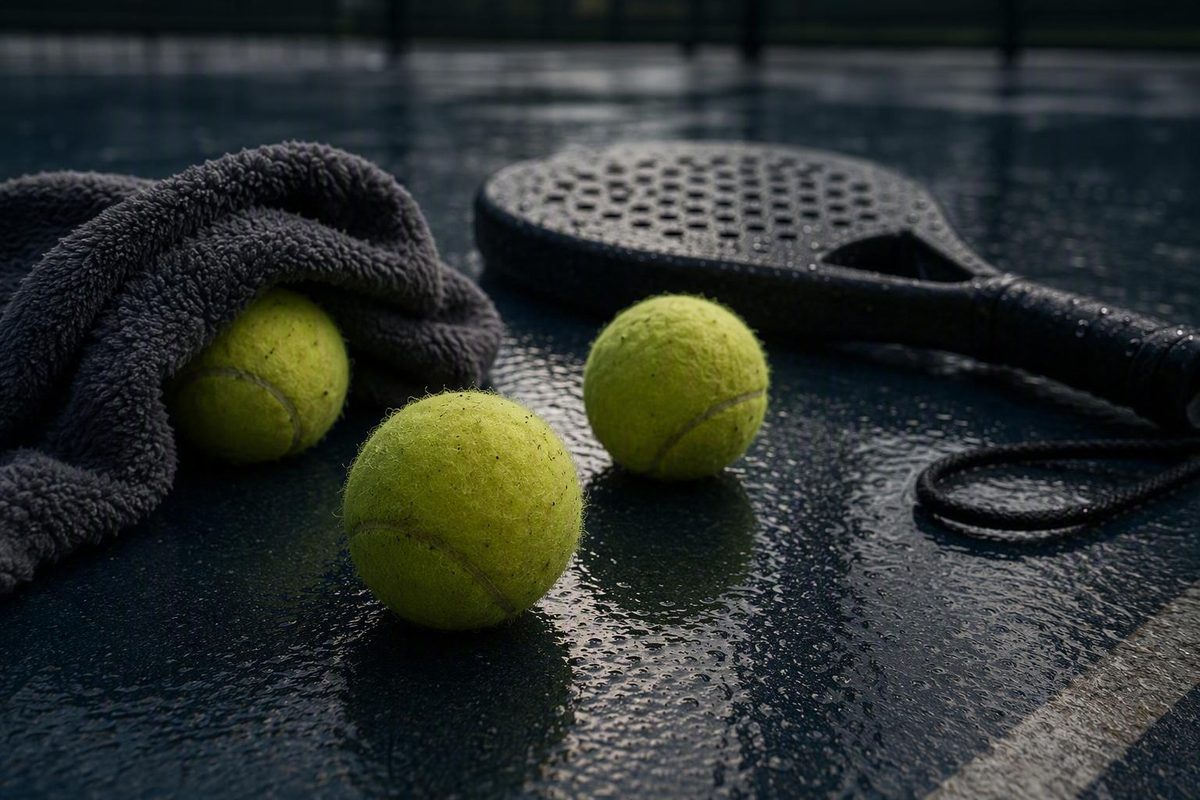
Pressurized padel balls can become less lively as gas gradually escapes after the can is opened, but feel alone does not prove pressure loss. Cold conditions, damp or worn felt, different ball construction, and inconsistent comparisons can create similar symptoms. Stabilize the conditions, compare every ball in the set, and judge them by repeatable rebound and predictable play—not a fixed match count.
The quick answer: diagnose a flat-feeling ball
First, establish whether the change affects the whole set or one ball. Players may notice lower or irregular rebound, shorter returns from the glass, slower rallies, a duller impact sound, easy compression, damaged felt, or inconsistent behavior within the same tube.
Players do report balls feeling flat late in a session, including in this community discussion about a perceived loss of air. However, that report contains no pressure or rebound measurements. Treat the sensation as a reason to investigate, not as proof of pressure loss.
| What you observe | Issue to investigate | Next step |
|---|---|---|
| All balls feel sluggish in the cold | Temporary temperature effect | Let them reach a stable room temperature, then retest |
| Balls are damp or feel heavy | Moisture in the felt | Dry them with airflow at room temperature |
| One ball behaves differently | Ball-specific wear, damage, or pressure loss | Segregate it and compare it with the rest of the set |
| Felt is badly worn, peeling, or uneven | Cover deterioration | Move the ball out of match play |
| Rebound remains consistently low under matched conditions | Persistent performance loss | Reassign the set to drills or replace it |
Not all checks are equally useful. Rank them this way:
- Repeatable rebound measurements and consistency among the balls
- On-court behavior, including glass returns, rally speed, and predictability
- Sound and squeeze checks, used only as supporting clues
A dull sound or easy compression may indicate deterioration, but neither identifies the cause. More persuasive signs are a persistently low or irregular rebound, one ball behaving materially differently from the rest, severe felt damage, or unpredictable reactions from the court and glass after the set has been retested under stable conditions.
Why pressurized padel balls lose responsiveness
A pressurized ball returns energy through a combination of internal gas pressure and the elasticity of its rubber core. Once the can is opened, gas can gradually pass through the rubber. As the pressure difference between the inside of the ball and the surrounding air declines, the ball may rebound lower, travel more slowly, and feel less responsive.
Pressure loss and felt wear are separate processes. A ball can lose useful bounce while its felt still looks clean. Conversely, internal pressure may not be the main problem if the felt is wet, badly fluffed, peeling, or worn unevenly. The cover affects the ball’s movement through the air, its grip on the court, its response to spin, and its reactions from the glass.
Balls should not be treated as mechanically identical. Manufacturers use different core constructions and designs intended to affect feel and pressure retention; for example, HEAD describes distinct cores and pressure-retention technologies across its padel-ball range. That establishes that construction varies, not that one model will last a particular number of sessions.
If you come from tennis, your experience still helps: you probably recognize the heavy, unresponsive sensation of an ageing pressurized ball. What does not transfer is the assumption that tennis and padel balls have identical specifications or respond identically in the same conditions. Whenever possible, compare a padel ball with others of the same model.
How to check bounce consistently at home
A useful home test is not about producing one supposedly perfect result. Its value comes from detecting change under repeatable conditions.
- Label each ball with a small identifier.
- Use the same hard, level surface for every test.
- Let all balls reach the same stable temperature.
- Measure the drop height from the bottom of the ball.
- Release the ball without pushing, throwing, or adding spin.
- Record the height of the first rebound.
- Repeat the drop several times and look for a consistent pattern rather than selecting the most convenient reading.
- Compare like with like: use the same ball model, surface, temperature, drop height, and method before and after play.
Test every ball in the set. A suspect ball that repeatedly rebounds well below the others provides more useful evidence than a general impression that the set felt slow.
For context, the 2026 FIP approved-ball certification document specifies a rebound of 135–145 cm for a standard ball dropped from 2.54 metres onto a hard surface. You can borrow that geometry at home or choose another carefully controlled drop height for tracking relative change. Either way, a home test does not reproduce laboratory controls or certify that a ball complies with competition requirements.
Squeeze, sound, waist-height, and shoulder-height checks are only screening tools. Informal commercial guides use different drop heights and expected rebound points, so those shortcuts cannot establish how much pressure a ball has lost.
Keep a simple record so that memory does not become part of the test.
| Ball ID | Opening date | Playing hours | Conditions |
|---|---|---|---|
| A | Date | Approximate total | Temperature; dry or damp |
| B | Date | Approximate total | Temperature; dry or damp |
| C | Date | Approximate total | Temperature; dry or damp |
| Ball ID | Measured rebound | Felt condition | Intended use |
|---|---|---|---|
| A | Average or range | Clean, fluffed, worn, or damaged | Match, drill, or retire |
| B | Average or range | Clean, fluffed, worn, or damaged | Match, drill, or retire |
| C | Average or range | Clean, fluffed, worn, or damaged | Match, drill, or retire |
Playing hours are generally more useful for your own tracking than “matches.” A match might mean a short social set or a long, intense contest.
Flat, cold, damp, or worn? Separate the likely causes
Cold: If the whole set suddenly feels sluggish in cold conditions, allow the balls to reach a stable room temperature before retesting. A return to the previous rebound pattern points toward a temporary environmental effect rather than established permanent deterioration.
Damp: Wet felt can make a ball feel heavier and behave less predictably. Remove damp balls from the bag and dry them at room temperature with airflow. Do not use direct high heat. Reassess the set only when the balls are evenly dry.
Worn: Fluffed, thinning, peeling, or uneven felt can change speed, spin, and reactions from the court or walls. Felt damage is visible; pressure loss may not be. Either can make a ball unsuitable for match play.
Comparisons can also be distorted by hitting intensity, repeated impacts, court abrasiveness, storage conditions, and construction differences between models.
In padel, reduced or irregular rebound becomes especially noticeable after contact with the glass. Returns may come forward less, rallies may slow, and players may mistime shots because the ball no longer follows the expected path. If the symptoms disappear once the balls are warm and dry, replacement may be unnecessary. Persistent symptoms under matched conditions make deterioration the more plausible explanation.
When to keep, downgrade, or replace the balls
There is no universal expiration rule. One retailer guide estimates roughly two to three competitive matches or three to five recreational matches for pressurized balls, but it does not provide controlled testing for those ranges. Its use of “match” also leaves substantial variation in playing time and intensity.
Useful life depends on total court time, hitting intensity, environmental conditions, ball construction, storage, and the consistency you require. A social practice group may accept a slower but predictable set that competitive players would remove from match use.
| Category | Performance standard | Decision |
|---|---|---|
| Match balls | Consistent rebound and predictable reactions across the set | Keep for matches |
| Practice balls | Less lively but sufficiently consistent for the intended drill | Use for drills, warm-ups, or controlled feeds |
| End-of-life balls | Persistently inadequate or irregular rebound, wet damage, severe felt wear, or damaged rubber | Remove from play |
Elapsed time and felt appearance are not enough. A clean-looking ball may already rebound poorly, while an older but predictable ball may remain suitable for drills.
The FIP certification procedure permits a maximum rebound change of 4 cm after a durability test simulating nine games. That is a product-certification benchmark, not a promise that a retail tube will provide nine games—or nine matches—of useful consumer play. The same document allows a sufficiently deteriorated ball that differs from the others to be replaced under referee supervision, while organizers may announce scheduled ball changes.
If you play in a league or tournament, check the current rules, approved-ball requirements, and ball-change policy for that specific event. Do not assume another club or competition uses the same arrangement.
Storage habits—and what pressurizers can and cannot claim
Keep opened balls cool and dry. Remove them from hot cars, cold garages, and wet kit bags instead of leaving them exposed to prolonged temperature extremes. Dry damp balls at room temperature before storage, and keep each set together so you can track its use and consistency.
Good storage may help preserve useful performance, but it cannot prevent deterioration indefinitely. It is also important to separate three different outcomes:
- Preserving remaining pressure: slowing further decline
- Restoring some internal pressure: increasing pressure after it has fallen
- Restoring complete playing performance: recovering pressure, rebound, felt condition, and consistent behavior
Pressurizer sellers claim that storing balls under pressure can maintain bounce and sometimes restore bounce to flat balls. For example, the PressureBall seller markets its device for both preservation and restoration, but the page does not provide independent comparative testing that quantifies either result. Seller pressure settings are product instructions, not official padel standards, and a pressurizer should not be assumed to make every used ball play like new.
Complete playing performance depends on more than pressure alone.
To evaluate a pressurizer for your own use, begin with two comparable sets. Give them similar court time in similar conditions, store one conventionally and the other in the device, and test both using the same surface, temperature, and drop method. That comparison may inform your storage choice, but it does not establish a universal result for other ball models, devices, or playing conditions.
Do pressureless padel balls last longer than pressurized balls?
They may remain usable longer because their rebound relies more heavily on rubber construction than retained gas pressure. They also tend to feel different, often less lively or heavier in play, and their useful life still depends on rubber condition, felt wear, and consistency. Check whether the specific ball is suitable or approved for your intended competition.
Can a padel ball look new but already have lost bounce?
Yes. Performance can decline before the felt looks badly worn. Compare the ball’s measured rebound and on-court behavior with the rest of the set rather than judging it by appearance alone.
Can cold weather make padel balls feel flat temporarily?
Yes. Cold conditions can make an entire set feel less responsive without proving permanent pressure loss. Let the balls reach a stable room temperature, then repeat the same rebound test.
The practical rule is simple: stabilize the conditions, compare the balls consistently, and assign their role according to predictable performance. Keep consistent balls for matches, move less lively but reliable balls to drills, and replace balls that remain irregular or inadequate after retesting.