
What is padel? Learn the court, rules and first rally
Padel is a doubles racket sport with playable walls. Learn the equipment, serving, scoring and court habits you need for your first session.
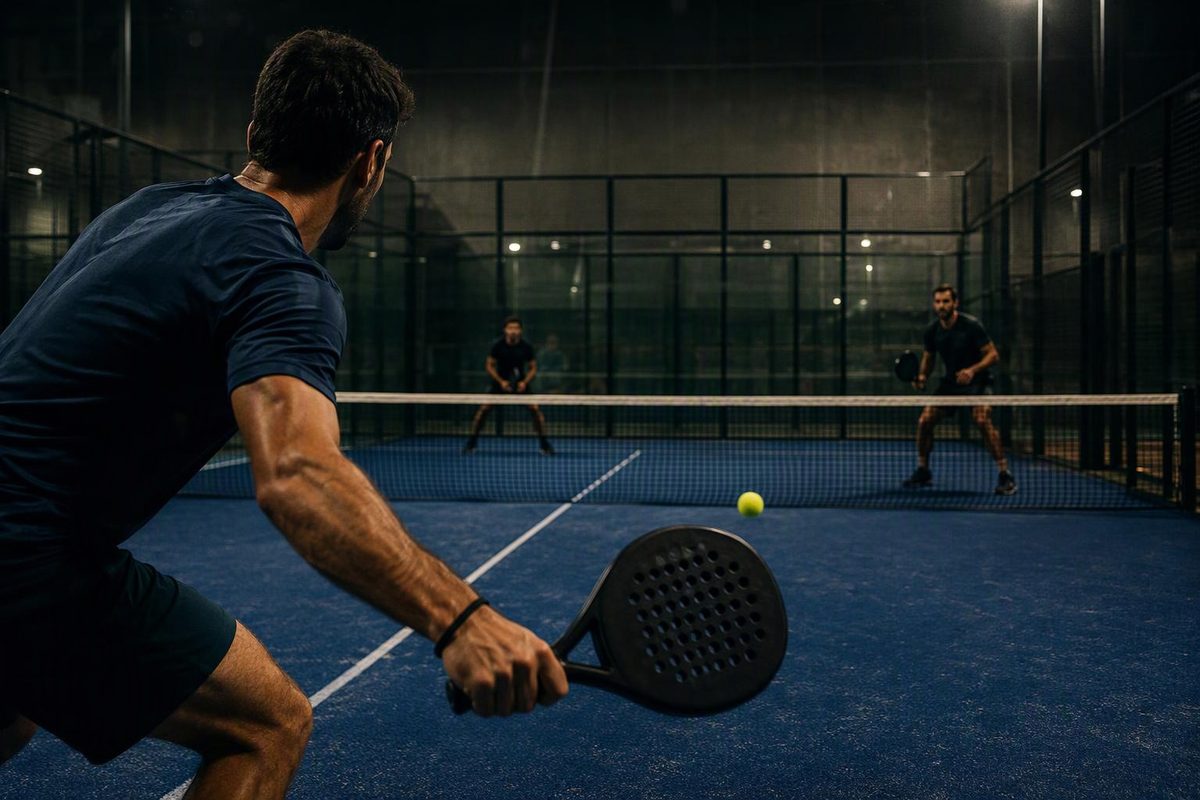
Padel is a racket sport normally played as doubles on an enclosed court, with a net in the middle and walls that are part of the game. You hit the ball over the net, but a shot that bounces on your side and then rebounds off the glass is still playable. Return it before its second floor bounce.
That rebound is the biggest adjustment for a tennis player: a ball passing you is not necessarily a lost point. The LTA’s beginner rules guide explains the basic pattern: underarm serve, rally over the net, and no more than one floor bounce before a return.
The court and equipment
A standard padel court is 20 metres long and 10 metres wide, divided by a net and enclosed by walls—often glass—and metal fencing. Four players share the court, two on each team. The service lines mark where serves must land; during rallies, the playable floor extends behind them to the back wall. These dimensions and markings are specified in the International Padel Federation’s rules.
You use a short, stringless racket with a perforated hitting face and padel balls that resemble tennis balls. Put the racket’s safety cord around your wrist before playing: its use is mandatory under the FIP rules.
For a first session, ask the venue whether it supplies rackets and balls, and wear shoes suitable for lateral movement on its court surface.
How a point works
1. Start with an underarm serve
Serve from behind the service line, on the correct side of the centre line’s imaginary extension. Bounce the ball in that serving area, then strike it at or below waist height, keeping at least one foot on the ground. Neither foot may touch the service line or imaginary centre line.
The serve travels diagonally into the opposite service box; a ball landing on the box line is in. Start each game from the right and alternate sides after each point. You get a second attempt if your first serve is a fault.
The receiver must let the serve bounce. If it lands correctly and rebounds off glass, it can still be returned. If it touches the metal fence before its second floor bounce, it is a fault. These requirements follow FIP Rules 6–8.
2. Rally—and use the rebounds
After the return of serve, you can volley—hit before the bounce—or play after one floor bounce.
Remember these distinctions:
- Floor, then glass or fence: the ball remains live during a rally. Return it before the second floor bounce.
- Opponent’s glass or fence before their floor: if your shot hits either before bouncing in their court, you lose the point.
- Your own wall: you may hit a return off it so the ball travels into the opponents’ court. You cannot use your own metal fence this way.
Those wall and fence rules are set out in FIP Rules 12–14.
Picture one rally: your opponent hits deep; the ball bounces on your floor, hits the back glass and comes forward. You move into space, return it before it touches the floor again, and the point continues. The wall rebound did not use up another floor bounce.
How scoring works
Padel uses tennis-style points: love (zero), 15, 30, 40, game. A usual set is first to six games with a two-game lead, with a tie-break at 6–6. In that tie-break, count 1, 2, 3 and so on: first to seven with a two-point lead wins. Matches are commonly best of three sets.
Agree what happens at 40–40, called deuce, before starting. The 2026 FIP rules include three options: advantage scoring requires two consecutive points from deuce; Golden Point decides the game with one point at deuce; Star Point allows up to two advantage exchanges before a deciding point.
Your first court habit: control before power
Tennis forehands, backhands, volleys and lobs transfer, but big swings and hard smashes are not always helpful. A powerful shot can rebound off the glass into an easier return. The LTA’s tennis-to-padel guidance recommends shorter racket movements and control rather than relying on power.
Try this before scoring: with your partner beside you in the back half of the court, ask an opponent to feed gentle, deep balls. Let a suitable ball bounce and rebound from the back glass, then use a compact swing to return it.
Checkpoint: can you identify “floor, glass, hit” and make contact before bounce two without crowding the wall? If so, begin gentle rallies. For the next step, learn where to stand and how to move with your partner, rather than following every ball independently.