
Padel Doubles Positioning: Move With Your Partner
Learn where to stand when serving, returning and rallying, when to take the net, and how to move with your partner without leaving the middle open.
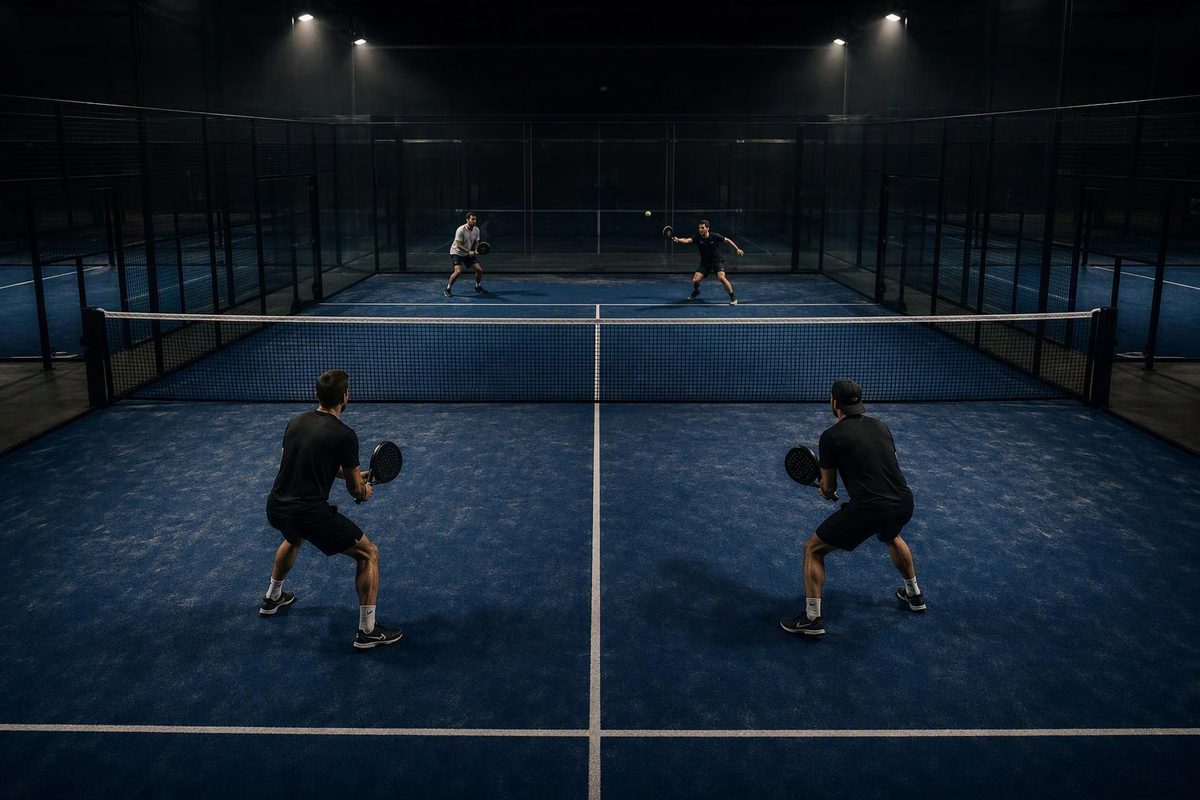
The simplest starting point for padel doubles positioning is both back to defend, both forward to attack. Avoid settling into a tennis-style one-up, one-back formation: it leaves a diagonal gap between you that opponents can target. The LTA’s beginner guidance describes these two main positions and emphasises moving together; The Padel School explains the diagonal gap.
“Together” means responding to the same situation—not standing shoulder to shoulder or matching every footstep. Brief differences in depth are normal while one player serves, retrieves a ball or plays an overhead.
Where to stand at the start of a point
When serving: try a simple beginner setup with your partner already in a forward position on their side. After serving, move towards the net to join them. Get balanced and ready as the receiver hits, rather than charging forward regardless of the return. The LTA’s serve guidance treats the serve as a way to reach the net, not simply a chance to hit an ace.
When receiving: both players start back. A useful starting reference is about one step behind the service line and two steps in from the side glass, then adjust to the serve and your reach. The non-receiver stays alert rather than drifting forward alone. This returning setup is explained in The Padel School’s guide to moving as a pair.
Treat those starting spots as tactical references, not fixed positions for the whole rally.
During the rally: choose your depth together
Both back: defend and create an opening
Recover into the area behind the service line, with space to turn and play a rebound rather than standing against the back glass. Adjust your depth to the incoming ball; do not plant your feet on one spot.
Your task is to make a controlled return and find a chance to move forward. A lob—a high shot over the opponents—can create that chance by pushing them away from the net. The LTA’s match-tactics guide recommends using lobs to give both players time to take an attacking position.
Move on what your shot achieves, not what you intended. If your lob forces the opponents back to defend, advance together. If it hangs within easy overhead reach, do not rush underneath their next shot.
Both forward: cover the net without crowding it
Stand well inside the service line, but leave room between you and the net. You need to cover volleys while remaining able to turn for a lob. Being too close or too far back are both common errors highlighted by The Padel School’s net-position guidance.
If a lob forces your partner all the way back to defend, retreat with them. If they only need a short retreat for a controlled overhead and can recover forward, you need not both abandon the net. This distinction is part of The Padel School’s pair-movement guidance.
Move sideways to protect the middle
Your starting side is your responsibility, not a box you must stay inside.
Imagine your partner is pulled towards the right-side glass. Shift right towards the middle to reduce the gap between you. When they recover, rebalance across the court. Do not follow them into the corner: you are covering the space they have left, not chasing the same ball.
This applies both at the net and in defence. The Padel School specifically recommends the free partner adjusting towards the centre when the other player is pulled wide.
For a ball between you, call early. Do not assume every middle ball belongs to the forehand player; agree a default and let the better-positioned player call when necessary. Use these partner communication calls to keep the decision simple.
Practise one complete positioning sequence
With four players, start one pair back and the other forward. Play gently enough to focus on movement:
- The back pair rallies until one player can send a lob that forces the net pair back to defend.
- The back pair advances together; the displaced pair retreats together.
- Continue the point. Whenever someone is pulled wide, their partner shifts towards the middle.
- Reset and repeat, then swap starting roles.
Checkpoint: at each opponent’s contact, ask: “Are we balanced, in the same attacking or defending zone, and covering the gap between us?” If one player is stranded forward while the other defends, identify the shot that split you and repeat that transition.