
Find a Padel Grip Fit That Stays Stable Without Clenching
Check padel racket handle thickness, understand replacement grips and overgrips, wrap a fresh layer, and adjust fit without tennis grip-size labels.
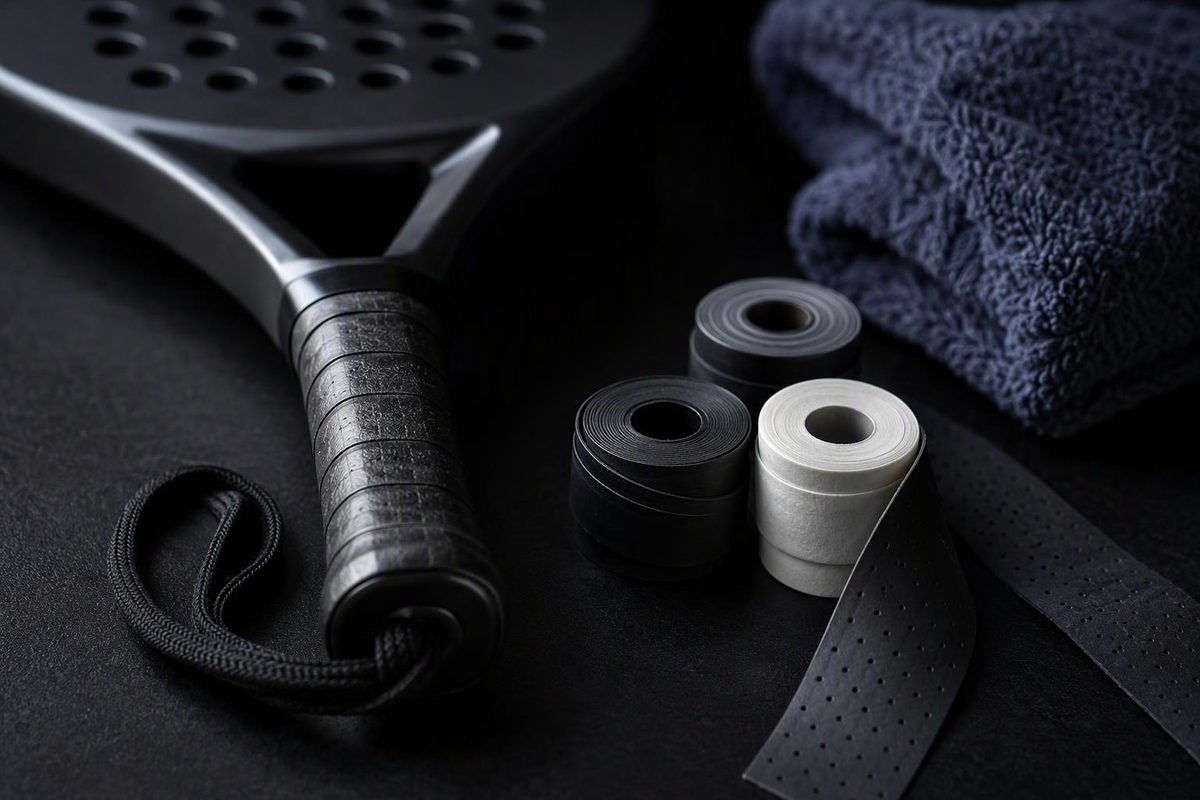
For most beginners, the right racket grip setup is a continental hand position, the factory replacement grip left in place and one overgrip. Adjust the number of overgrips only until the racket stays stable without a constant hard squeeze; padel does not use a universal hand-sizing chart comparable to tennis grip labels.
Choose the fit, stability and surface cues that match your handle; the tool gives you the next adjustment to try.
Racket Grip Fit Check
Match what you feel while holding continental and playing controlled volleys.
Your Next Step
Keep the base grip and one overgrip.This is a useful starting fit: comfortable finger clearance and stability without clenching.
Sources: FIP Rules of Padel effective 1 January 2026 for handle limits; The Padel School for the continental position and wrapping method; LTA tennis guidance for the finger-gap cue.
“Racket grip” can mean either the position of your hand or the material wrapped around the handle. Both affect control, but adding layers cannot correct an unsuitable hand position or consistently poor contact.
Use Continental As Your Default Hand Position
Hold the racket upright with its edge pointing forward, then take the handle as though you were holding a hammer. This is the continental grip, the neutral starting position commonly used for forehands, backhands and volleys in padel. The Padel School describes it as the sport’s base grip and recommends returning the non-playing hand to the racket between shots (The Padel School).
Tennis players may be accustomed to rotating towards a forehand grip from the back court. In padel, first learn to keep continental through quick forehand and backhand exchanges. Small shot-specific adjustments can come later.
For the full hammer test, hand placement and pressure drill, see how to hold a padel racket.
Padel Rackets Do Not Have a Universal Grip-Size Chart
There is no FIP hand-sizing chart equivalent to the familiar tennis L1, L2 and L3 system. The rules effective from 1 January 2026 instead set maximum handle dimensions: 20 cm long, 50 mm wide at the throat and 50 mm thick (FIP Rules of Padel). They do not prescribe a retail grip size for each hand.
Handles can therefore feel different between racket models, while shops and manufacturers may use their own labels. Test the actual racket where possible rather than buying from a grip-size label alone.
Finger Position Gives You a Starting Fit
Wrap your fingers naturally around the handle in continental and check where the fingertips finish.
- Likely too thin: Your fingertips press firmly into your palm, or the handle turns unless you squeeze hard.
- Likely too thick: You struggle to wrap your fingers comfortably around the handle.
- Useful starting fit: There is a small gap between your fingertips and palm, and you can keep the racket stable with relaxed pressure.
The familiar test of placing one index finger in that gap comes from tennis fitting. The LTA’s tennis grip guide says no space suggests a grip is too small, while excess space suggests it is too large. Treat that as a starting check for padel, not a padel sizing rule.
Test the result in motion before changing the handle. Play several controlled forehand and backhand volleys without rotating your hand around it. If the racket repeatedly twists, first check that you are contacting the ball cleanly. If clean contact still requires you to clench throughout the drill, the grip may be worn, slippery or too thin.
Keep the Replacement Grip Under the Overgrip
A replacement grip is the thicker base layer fitted directly to the handle. An overgrip is the thinner, replaceable layer wrapped over it. The overgrip improves traction, absorbs moisture and increases the handle circumference slightly.
Start with one overgrip over the intact factory replacement grip. If the handle still feels too thin, add another overgrip and repeat the fit and volley checks. If it feels too large, remove surplus overgrips rather than trying to stretch your hand around them.
Do not remove the replacement grip when changing a worn overgrip. Removing that base layer changes the handle more substantially and leaves less cushioning over its underlying structure.
Extra layers also make the handle’s angled edges, or bevels, less distinct. Those edges help you sense the racket’s orientation in your hand. Copying another player’s number of layers is therefore less useful than checking whether your fingers wrap comfortably and the racket remains stable at relaxed pressure.
Wrap the Overgrip From the Butt End Upward
- Remove the worn overgrip and its finishing tape, leaving the replacement grip underneath.
- Place the tapered end of the new overgrip at the bottom of the handle.
- Make the first turn around the butt end to anchor it.
- Continue diagonally towards the racket face with a small, consistent overlap.
- Keep even tension so the wrap lies flat without gaps or wrinkles.
- Trim the excess at the top and secure it with finishing tape.
Use slightly more overlap for a fuller handle or less overlap for a thinner result. The Padel School’s overgrip instructions likewise advise starting at the bottom, pulling the material snugly and changing the overlap to adjust thickness.
The wrap should be secure without being stretched so aggressively that it becomes uneven. Wrinkles and changing overlap create high spots that can make the handle feel less predictable during quick grip changes.
Replace a Slick Overgrip Before Adding More Layers
Replace the overgrip when it becomes slick, flattened, frayed or difficult to hold. Do not compensate for a worn surface by squeezing harder through every rally.
If the thickness previously felt right, replace the worn overgrip with a fresh one before adding another layer. Stacking a new overgrip over a worn one changes the circumference and softens the bevels when the actual problem may only be lost traction.
After wrapping, repeat the relaxed hold and controlled-volley checks. The useful setup is the thinnest one that gives you comfortable finger clearance, dependable traction and stability without continuous clenching.
Put the Safety Cord On Before Taking the Handle
Put your hand through the safety cord before taking the handle. Under the 2026 FIP rules, the cord must be non-elastic, fixed to the handle, no longer than 35 cm and worn around the wrist during play (FIP Rules of Padel).