
Hold Your Padel Racket With the Continental Grip
Find the continental padel grip with a hammer test, set safe grip pressure, correct common errors, and practise several shots without rotating your hand.
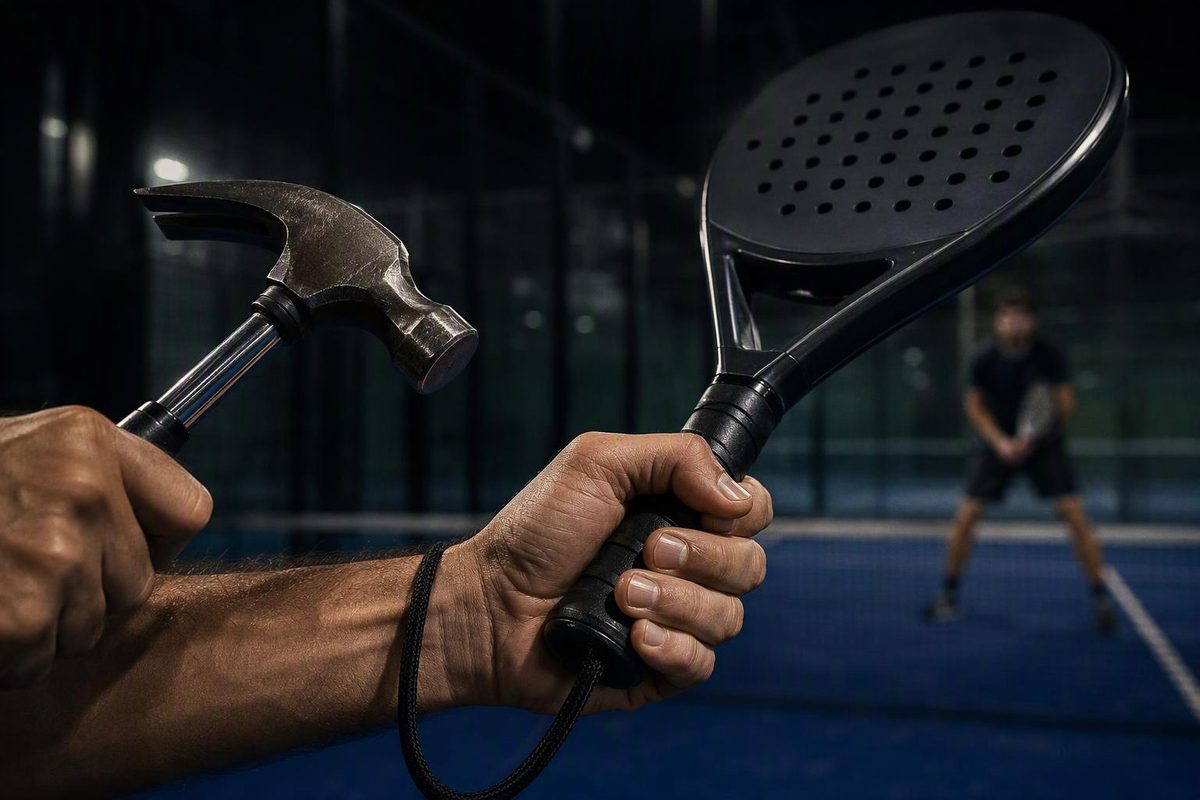
Hold a padel racket with the continental grip: a neutral, hammer-like hold that lets a beginner play forehands, backhands, volleys and overheads without rotating the hand for every shot. Padel coaching sources teach it as the base grip because it works across many situations (The Padel School, PadelMBA).
If you come from tennis, this is the main adjustment: continental may be one of several familiar tennis grips, but in padel it should become your default.
Choose what you see and feel; the grip check identifies the correction to make.
Continental Grip Check
Keep This Continental Default
An approximately vertical face, relaxed pressure and no hand rotation match the beginner checkpoint. Keep the non-playing hand on the racket between shots.
Method source: continental-grip guidance from The Padel School and PadelMBA.
Set the Continental Grip in Five Steps
- Put the safety cord around your playing wrist. Do this before taking the handle. Under the FIP rules effective from 1 January 2026, the cord must be fixed to the handle, worn around the wrist and no longer than 35 cm; its use is obligatory (FIP Rules of Padel).
- Hold the racket upright with your non-playing hand. Keep the hitting faces pointing to the sides, as though you could hammer a nail with the racket’s edge.
- Take the handle with your playing hand as if holding a hammer. Another useful cue is to “shake hands” with the racket while it remains upright.
- Wrap your fingers naturally. Keep the index finger slightly separated from the other fingers instead of bunching all four together. Let the thumb rest comfortably around the handle rather than pointing straight up it.
- Hold near the bottom of the handle. The heel of your hand can sit close to the end cap, but it should not hang so far off that the racket feels unstable.
The method is the same for right- and left-handed players; it simply mirrors with the playing hand.
Check the Racket Face and Wrist
Extend the racket gently in front of you with your forearm and wrist in a comfortable, neutral position. The racket face should be approximately vertical, not facing the ceiling like a frying pan. You should also be able to present the racket’s edge forward without forcing your wrist into an awkward angle.
Do not rely too heavily on numbered handle bevels. Padel handle shapes vary, and bevel numbering can be explained differently. The hammer test is easier to repeat: hold the racket upright by its edge and take the handle as though it were a hammer.
Hold Securely Without Squeezing Constantly
Use enough pressure to stop the racket turning in your hand while keeping your fingers and forearm relaxed between contacts. Firm the hand briefly as needed when the ball meets the racket, then release that extra tension.
Test the pressure by bouncing a ball gently on the racket face. If your forearm is rigid or your knuckles stay white, loosen your hold. If the handle moves on every bounce, add a little pressure.
Grip pressure and grip condition are connected. A slick or worn handle encourages you to squeeze. An overgrip goes over the existing grip to improve comfort, sweat absorption and hold; a replacement grip restores the base layer after it has deteriorated (LTA Padel). Replace or adjust the grip rather than compensating with a permanent clench.
Keep the Same Grip Through a Simple Point
Imagine this sequence:
- You return serve with a compact backhand.
- Your opponents play a short ball, so you and your partner move forward together.
- The next ball comes quickly to your forehand volley.
- The following ball arrives at your backhand volley.
With continental, your playing hand stays in the same position for all three contacts. Your non-playing hand supports the racket between shots and helps guide the unit turn. You adjust the racket-face angle and contact point, not the whole grip.
That economy matters at the net, where changing from a tennis forehand grip to a backhand grip can make the racket late. It also leaves less to organise when a rebound changes the ball’s path. If you are new to those situations, first learn the court and rally basics in How to Get Started Playing Padel.
More experienced players may make small grip adjustments for particular shots, but a beginner should first build a dependable continental default.
Correct Three Common Grip Errors
The Racket Face Points Upward
In the frying-pan grip, the palm sits too far underneath the handle and the racket face points upward. It may feel comfortable on one forehand, but it makes the backhand volley awkward and encourages unwanted grip changes.
Reset by holding the racket upright with its edge forward. Take the handle again as though holding a hammer, then check that the face is approximately vertical when you extend it in front of you.
The Hand Stays Tightly Clenched
Constant squeezing stiffens the hand and forearm. Relax between contacts and firm the hand only as much as the shot requires. If relaxing makes the handle slip, inspect the grip or overgrip rather than immediately returning to a permanent clench.
The Support Hand Leaves the Racket
Relaxed does not mean careless. Keep the non-playing hand on the racket between shots. It steadies the racket, helps you prepare and gives you a repeatable position from which to check the grip.
Build the Grip With a Five-Minute Drill
Stand in a safe open space with the wrist cord fitted.
- Find continental with the hammer method.
- Hold the racket in front with both hands in a ready position.
- Turn for a compact forehand, return to ready, then turn for a backhand.
- Repeat 10 times without letting the playing hand rotate around the handle.
- Finish with gentle forehand and backhand volleys to a partner, aiming for control rather than speed.
After every shot, check three things: approximately vertical face at ready, relaxed fingers, and the non-playing hand back on the racket. Once that pattern is reliable, stop looking at your hand and keep your eyes on the ball.